



Sant Angelo in Grotte (English)
Musica di fondo

(Per ascoltare far scorrere il cursore)
Musica
Welcome to Sant’Angelo in Grotte, one of the most charming villages in Molise.
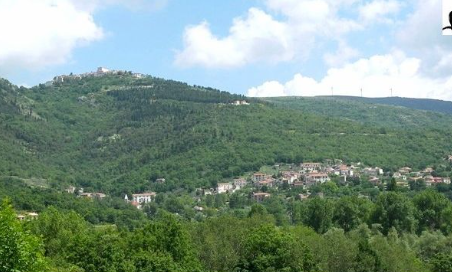
Take a moment to breathe in the pure air of this place and admire the landscape around you: mountains, silence, and unspoiled nature will accompany you throughout your visit.
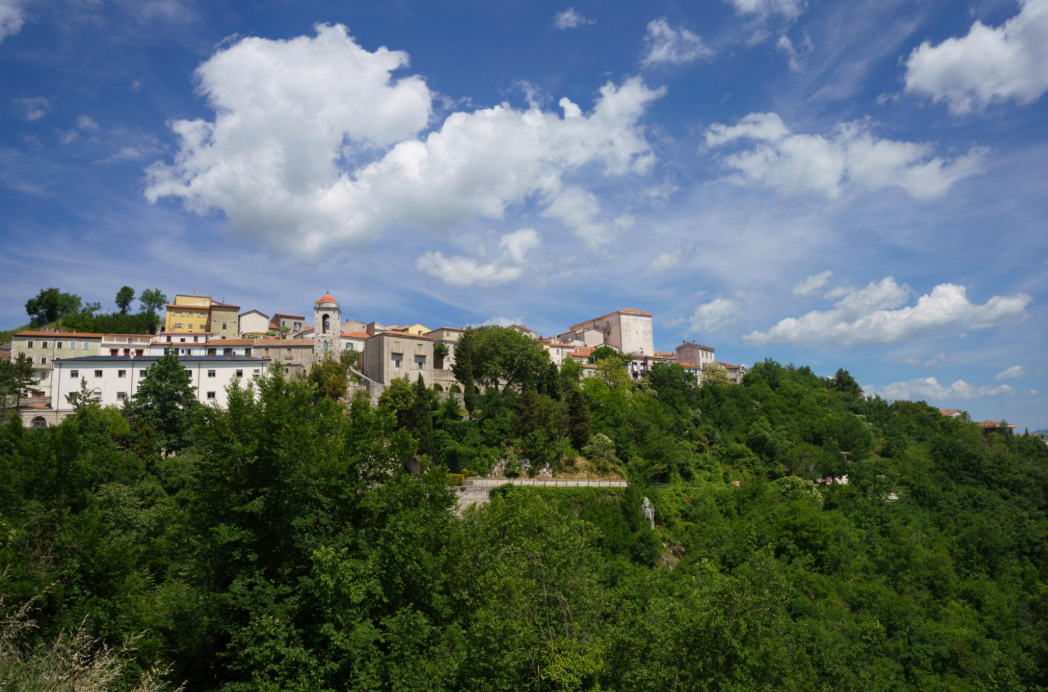
This small village preserves an ancient heritage shaped by generations of people, traditions, and spirituality, deeply connected to the land and the surrounding rock formations.
The Historic Village
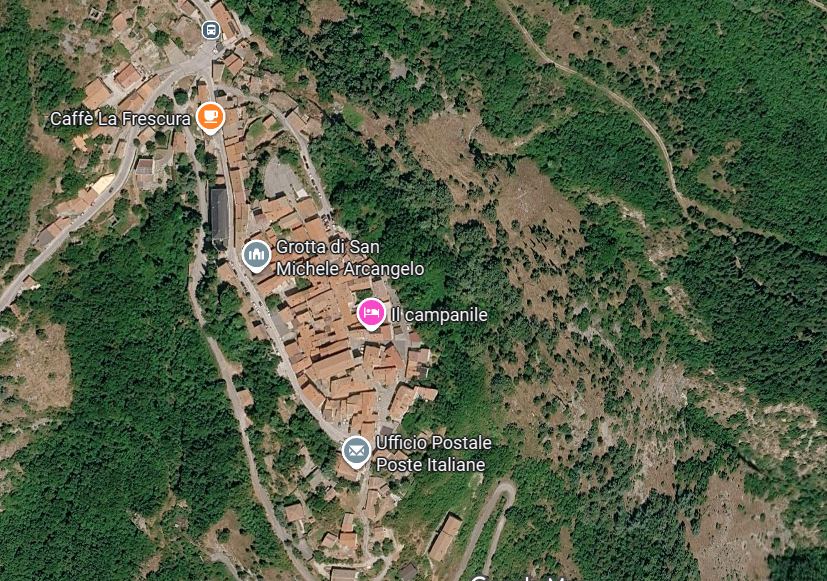
Let us now enter the heart of the village.
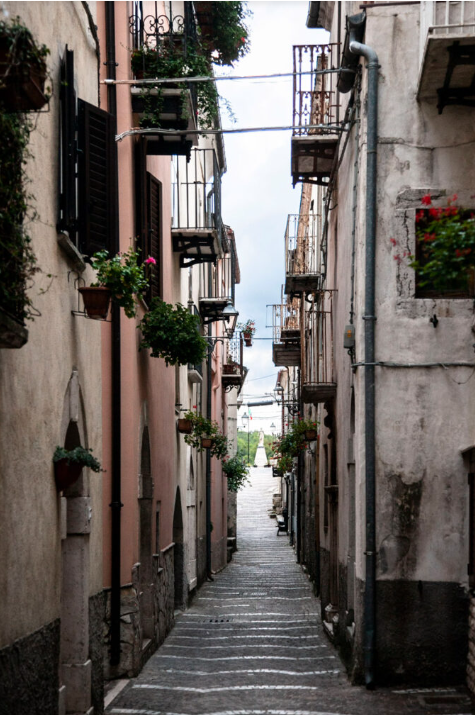
The stone houses, narrow alleys, and ancient arches tell the story of a simple way of life built on community and mutual support.
Here, time seems to have stood still: every door and every window preserves traces of past lives, families, and traditions handed down from generation to generation.

Our itinerary through the village of Sant’Angelo in Grotte begins in Largo Santa Barbara, where a station cross stands. Several such crosses can be found throughout the area, usually in front of churches.
The cross in Sant’Angelo in Grotte dates back to the eighteenth century and, at first glance, does not appear to be near a church. The reason is simple: today it is not. In fact, the small Church of Santa Barbara, which has since disappeared, once stood here.
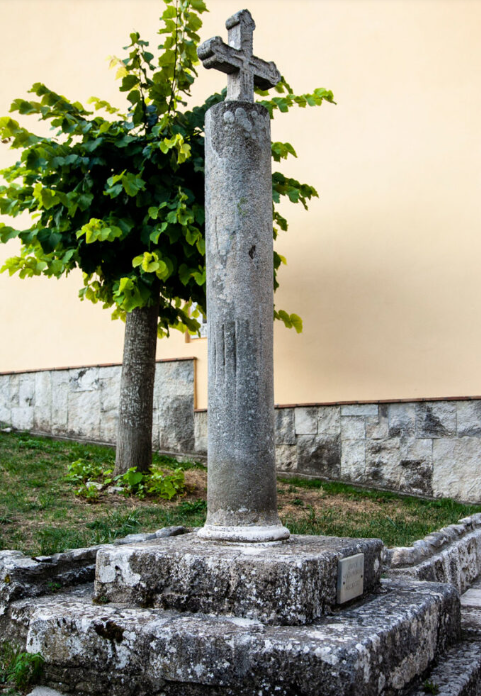
The station cross stands atop a tall circular column, which in turn rests on a squared stone pedestal that raises it above the ground. On the side facing the road, you can see a bas-relief depicting Jesus Christ on the Cross, with His feet appearing to rest upon the hair of a cherub. The arms of the cross are multilobed. On either side of Christ’s hands are Saint John the Evangelist and the Virgin Mary, while above His head are the inscription INRI and the image of a dove.
On the opposite side are carved several symbols of Christ’s Passion, including a ladder, a reed, nails, a hammer, a sword, a rope, and other objects associated with the Crucifixion.
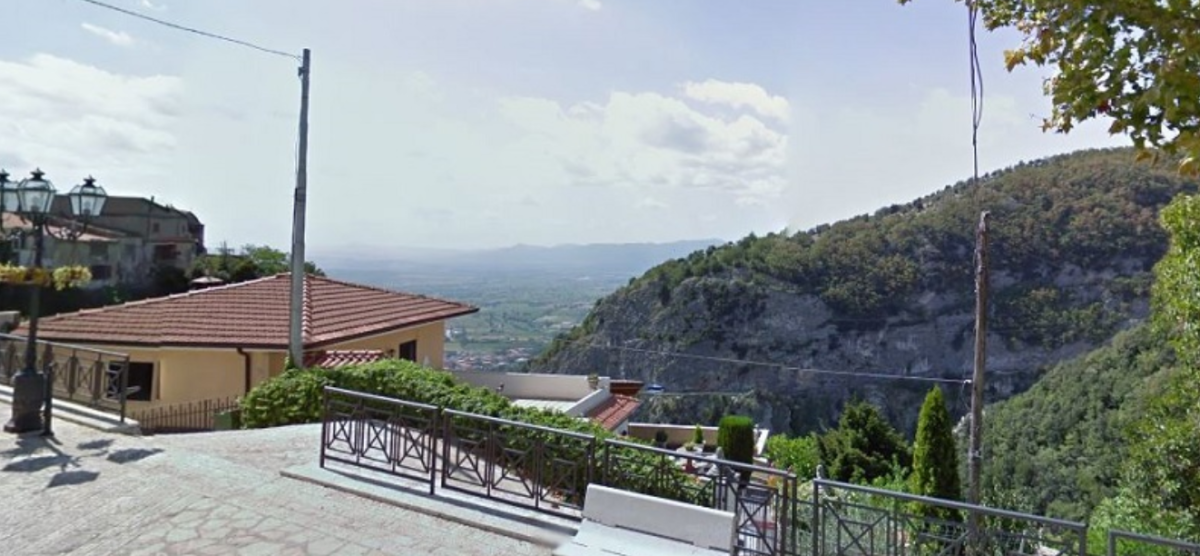
Now follow the village’s main street to the opposite end of Sant’Angelo in Grotte. You will arrive at a small square that serves as a panoramic viewpoint overlooking the surrounding cliffs.
In ancient times, the medieval castle stood here. It was later transformed into the Ducal Palace by the Mormìle family. Today, these structures have disappeared, and in their place stands a spacious terrace with benches where visitors can stop and relax. Several civic monuments can also be found here.
The Belvedere
This small square functions as a scenic terrace overlooking the dramatic cliffs below. As mentioned earlier, it was once the site of the medieval castle and later the Ducal Palace of the Mormìle family. Today, a spacious terrace with benches invites visitors to pause and enjoy the view, while several monuments enrich the setting.
Near the church, in Largo Garibaldi, there is a square known locally as Piazza Colonna. From here, you can enjoy magnificent views of the Bojano Valley and the surrounding peaks, including those of the Matese Mountains. On particularly clear days, you can even spot Monforte Castle in Campobasso. For this reason, the belvedere has earned the nickname “The Balcony of Molise.”
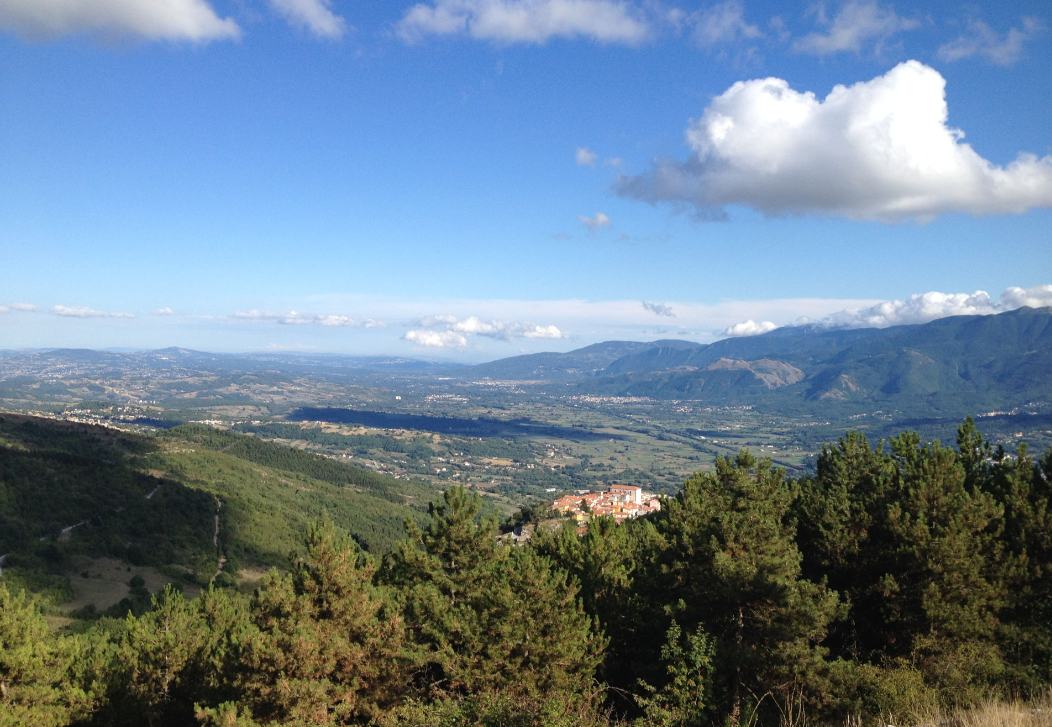
Piazza Colonna is also the venue for many of the village’s cultural events. Here stands a large eighteenth-century granite obelisk known as “The Merchant.” In the past, it was used to tie up and publicly punish offenders who had failed to meet their obligations.
On the opposite side of Piazza Colonna, you will find a sundial bearing the inscription “Horas Tibi Serenas,” a Latin phrase meaning, “May I always mark pleasant hours for you.”
At the center of the belvedere stands the War Memorial, dedicated to those who lost their lives during the First and Second World Wars.
This monument replaced an earlier memorial dating back to 1924, which commemorated the fallen of the First World War but was later destroyed during a bombing. The original memorial consisted of a stone stele.
The current War Memorial was inaugurated in 1966. Its base is formed by a pyramid supporting a life-sized statue of a soldier gazing toward the horizon. The names of those who fell in both world wars are inscribed on the base. Completing the monument are the Italian flag and a machine gun.
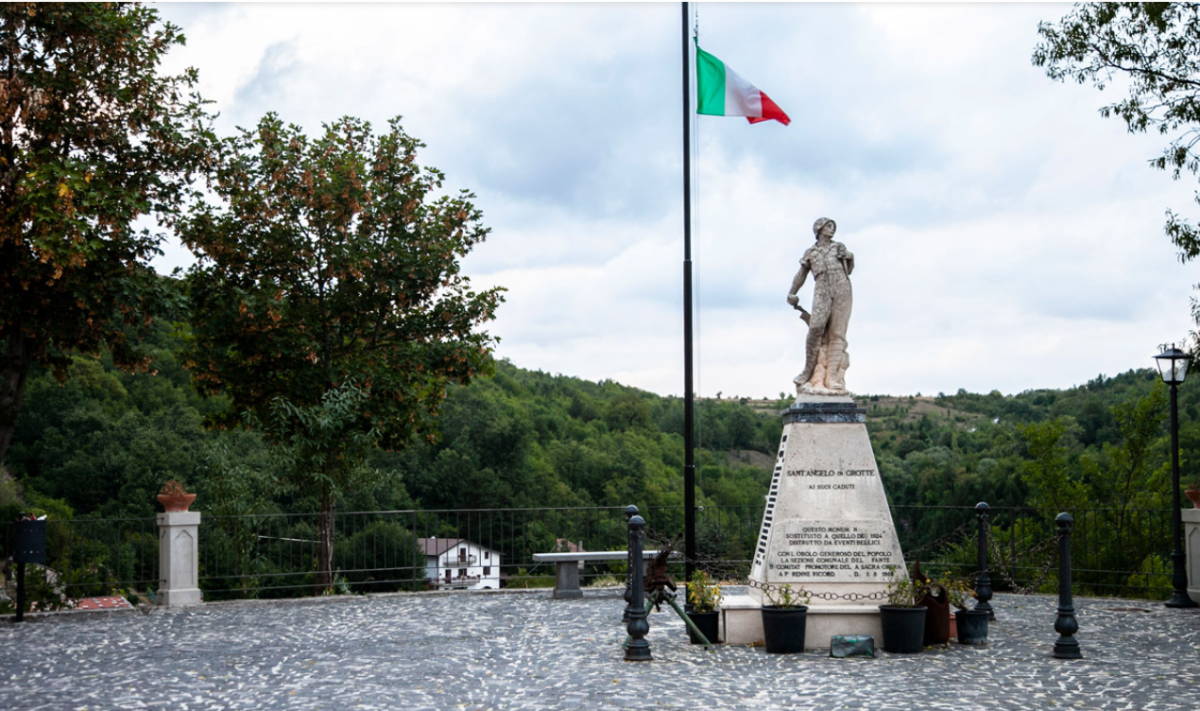
A short distance away stands the Church of the Sacred Heart, a modest single-nave building erected through the initiative of local parishioners and located near the War Memorial.
Inside the Church of the Sacred Heart is a statue of Saint Anthony, which contains a relic of the saint within its chest. It seems almost miraculous that a small bone belonging to a Franciscan friar born in Lisbon and who died in Padua should have found its way to Sant’Angelo in Grotte.
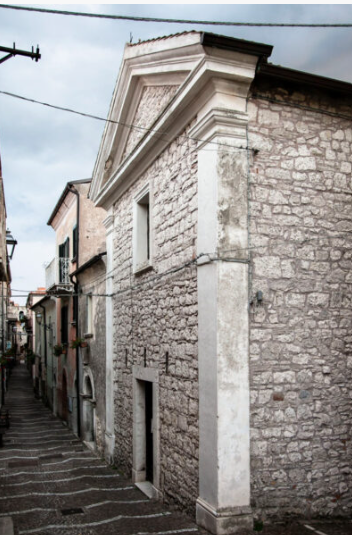
Outside the church, there is also a small grotto dedicated to Our Lady of Lourdes.
Church of Saint Peter the Apostle
Saint Peter
(Scroll to listen)
We are standing before the village’s principal place of worship: the Church of Saint Peter in Chains (San Pietro in Vincoli). For centuries, this has been the place where the community has gathered to celebrate life’s most important moments.

Before entering, take a moment to appreciate the quiet and contemplative atmosphere. This is the spiritual heart of the village, where faith and tradition come together.
Devotion to Saint Michael the Archangel and the distinctive shape of the rocky terrain overlooking the cave played a decisive role in the establishment of the first settlement. The village developed around a church initially dedicated to the Prince of the Archangels and later to Saint Peter, Christ’s first successor.
Anyone wishing to discover what the original Church of Saint Peter in Chains looked like will find it difficult to do so by observing the present building. The church we see today is the result of centuries of transformations and expansions caused by fires, wartime destruction, earthquakes, and periods of neglect. These events culminated in its reconstruction during the eighteenth century. Restored in recent years, the church now appears harmonious, elegant, and filled with light.
Immediately to the right of the entrance stands a beautiful stone holy-water font, while near the presbytery, also on the right, is an ancient baptismal font. The niches throughout the church contain numerous statues of saints. At the center of the presbytery, on a throne set against the wall, stands the statue of the parish’s patron saint, Saint Peter in Chains, carved from a large oak trunk.
At the far end of the church, above the apse, The Crucifixion, a painting by the Molisan artist Mario De Tollis, captures the attention of even the most distracted visitor. Through its harmonious colors and careful use of perspective, it conveys the drama of the event with remarkable intensity.
Across the vaulted ceiling, a succession of painted masterpieces unfolds, creating a heavenly spectacle to behold. Among the many statues, those of Saint Michael the Archangel and Saint Joseph, both carved in wood, stand out for their artistic quality.
We strongly recommend entering the church and visiting the crypt, which was rediscovered in the early 1950s.
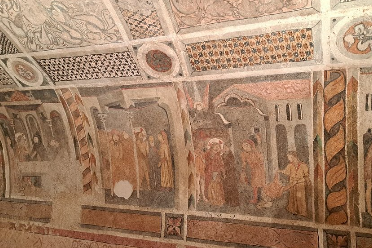
Preserved within the underground crypt is an extraordinary series of frescoes painted between the fourteenth and fifteenth centuries.
The panels depict the Seven Corporal Works of Mercy, culminating in a harmonious view of a medieval city representing Bethlehem and a radiant image of the Redeemer.
This is one of Molise’s least-known yet most captivating sites—a destination for true travelers.
The frescoes date from the late fourteenth century and were created by artists of the Sienese School, making them an outstanding example of medieval art. They cover the vault and all the walls of the small crypt.
Along the walls are scenes illustrating the Seven Corporal Works of Mercy, a theme that was especially widespread during the Middle Ages. It is believed that the patron who commissioned the frescoes was the local feudal lord who ruled the village at the time. The head of an angel depicted beneath the representation of Bethlehem may refer to the heraldic symbolism or family name of the patron.
The Seven Corporal Works of Mercy represented here are:
- Feeding the hungry
- Giving drink to the thirsty
- Clothing the naked
- Sheltering pilgrims and strangers
- Visiting the sick
- Visiting prisoners
- Burying the dead
These frescoes, dating from the second half of the fourteenth century, illustrate the Seven Corporal Works of Mercy. The sequence begins with an image of the city of Bethlehem, accompanied by a sun with a human face symbolizing God. Moving from right to left along the walls, the scenes unfold in succession: Feeding the Hungry, Giving Drink to the Thirsty, Clothing the Naked, Sheltering Pilgrims, Visiting Prisoners, and finally Burying the Dead.
It is truly remarkable to think that these masterpieces remained hidden for centuries before being rediscovered by pure chance and restored to their former splendor.
The Bell Tower of Saint Peter in Chains
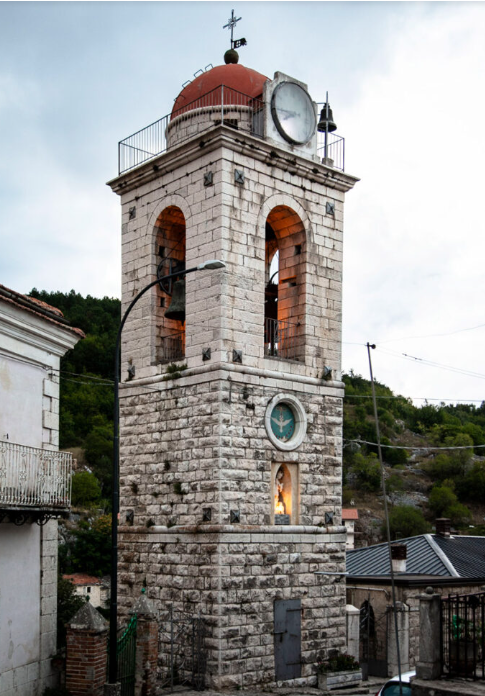
Older than the church’s most recent reconstruction is its bell tower, which dates back to the sixteenth century and bears a striking resemblance to the bell tower of the nearby cathedral in Isernia.
Built on a square plan, it features a large archway at ground level that allows visitors to pass through to nearby Piazza Colonna. Above, four tall arched openings house the tower’s four bells.
Projecting from one side of the bell tower are three stone sculptures depicting what appear to be lion heads. Their fierce expressions were probably intended to intimidate anyone passing beneath the archway, which in ancient times marked the entrance to the village.
Beneath the arch is an inscription referring to Pope Celestine V. Its origin has never been fully established and, according to some studies, it may have originated in Sant’Angelo in Grotte itself.
The Cave Church of Saint Michael the Archangel
The cave church
(Scroll to listen)
After visiting the crypt, we recommend descending the staircase beside the bell tower of the Sanctuary of Saint Michael the Archangel. Before you, a spectacular landscape unfolds, and you will feel as though you could almost touch the summit of Monte Miletto.
At the foot of the staircase, through magnificent bronze doors, we invite you to enter the Cave of Saint Michael, one of the finest rock-hewn churches in Molise and one of the most important European sanctuaries associated with the cult of Saint Michael.
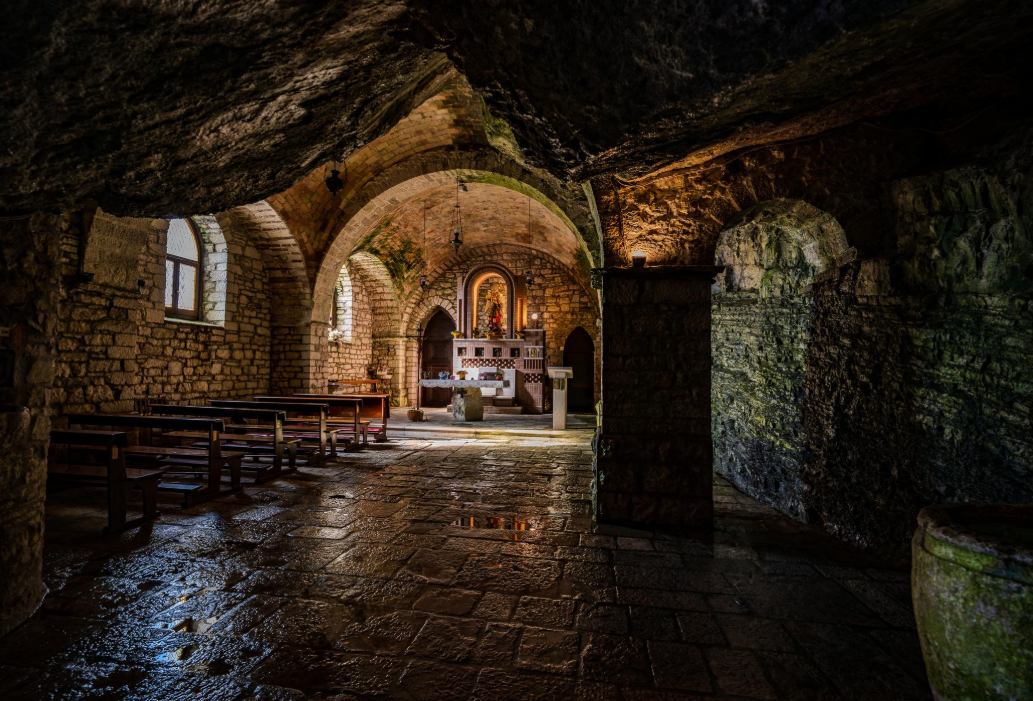
The Cave Church of Saint Michael the Archangel
Continue your visit to Sant’Angelo in Grotte by exploring one of its most remarkable attractions: the cave church.
Located at the base of the hill on which the village was built, it can be reached by following a descending path.
The Cave Church of Saint Michael the Archangel, also known as the Cave of Saint Michael, is carved directly into the rock beneath the village. Although the cave had existed for centuries, it was only during the Middle Ages that it was transformed into a church dedicated to the Archangel.
You enter the sanctuary through two bronze doors decorated with images of pilgrims and scenes from the Old Testament. Among the depictions are the Creation, the struggle against the Dragon, the Sacrifice of Isaac, and the Expulsion from the Garden of Eden.
Upon entering, you will find yourself in an elongated and irregularly shaped space where the typical elements of a place of worship have been added, including the altar, seating for the faithful, and the baptismal font.
Particularly noteworthy is the presence of a spring of water, traditionally believed to possess miraculous properties, which emerges from a natural cavity within the rock.
Inside the church, you will also find a throne adorned with bronze panels and a statue of Saint Michael the Archangel, depicted holding a sword in one hand and a globe in the other. These symbols represent his role as commander of the heavenly hosts and executor of the divine will.
According to local tradition, Saint Michael reached the nearby sanctuary of Monte Sant’Angelo on the Gargano through a passage carved into the rock.
The church of Sant’Angelo in Grotte is a fascinating rock-hewn sanctuary nestled within the mountainside at an altitude of approximately 1,000 meters above sea level. Dedicated to Saint Michael the Archangel, the cave is an ancient natural hermitage that combines spirituality and nature, enriched by architectural additions dating from the nineteenth century.
Probably established during the Middle Ages and renovated in 1890, the sanctuary features a white stone façade and an interior carved into the living rock. Access is through two bronze doors, one of which was created by the sculptor Urbano Buratti and depicts scenes from the Bible.
Devotion and Legend
The site occupies a central place in local devotion to Saint Michael and is linked to the Archangel’s famous apparitions on the Gargano.
According to legend, a hole in the rock inside the cave connects the sanctuary directly to the renowned Shrine of Monte Sant’Angelo in Apulia.
Within the sanctuary are a stone altar, a baptismal font, and a well that collects water flowing naturally from the rock, all surrounded by a uniquely evocative atmosphere.
Located at Via Vittorio Emanuele 28, in Sant’Angelo in Grotte, the sanctuary is a frequent destination for pilgrims and visitors alike.
The church is a historic site and privately owned property. It also houses several wooden statues, including the revered statue of Saint Michael the Archangel.
The area is renowned for its mystical atmosphere and is considered one of Molise’s most cherished and evocative places.
The Caves
The caves represent the most ancient soul of Sant’Angelo in Grotte.
Since ancient times, these natural spaces have been used as shelters, places of prayer, and refuges.
As you enter, you immediately perceive a profound sense of silence and connection with nature, almost as if time itself had stopped.
The most fascinating place to visit is undoubtedly the Hermitage of Saint Michael the Archangel.
This sanctuary is carved directly into the rock, within a natural setting that enhances its atmosphere of mystery and spirituality.
Here, silence is the true protagonist. Soft light filters gently through the rocky walls, creating a unique atmosphere that seems suspended in time.
For centuries, this sanctuary has been a destination for pilgrims devoted to Saint Michael, a symbol of protection, courage, and strength.
Water emerging from the rock is collected in a well, beside which stands an ancient stone basin.
According to local oral tradition, it was from this very cave that Saint Michael the Archangel reached the famous sanctuary of Monte Sant’Angelo on the Gargano through a passage within the rock.
Before leaving Sant’Angelo in Grotte, do not forget to photograph the roadside cross dating from 1537 and one of the village’s ancient houses with traditional stone roofs, known locally as liscie, now extremely rare reminders of the past."
Look around you: the Matese landscape is one of the most beautiful in Molise.
Forests, hills, and mountains create a natural environment that remains authentic and largely untouched by mass tourism.
Here, nature takes center stage, offering peace, tranquility, and beauty.
Sant’Angelo in Grotte is not just a place to visit; it is an experience to be enjoyed at a leisurely pace.
It is an invitation to rediscover the value of simple things: silence, nature, and memory.
This concludes our visit to Sant’Angelo in Grotte.
We will now move on to nearby Santa Maria del Molise to enjoy a pleasant moment of relaxation and companionship. A stop at the Mill Park (Parco dei Mulini) is highly recommended: a green oasis crossed by crystal-clear streams and refreshing waterfalls, offering the perfect setting for an outdoor picnic and friendly social gatherings in a specially equipped area with benches and relaxation spaces.
Parco dei mulini
To listen, move the slider.
A stop at the Mill Park (Parco dei Mulini) is highly recommended. This beautiful green oasis, crossed by crystal-clear streams and refreshing waterfalls, provides the perfect setting for an outdoor picnic and friendly social gatherings in a specially equipped area.
On this occasion, thanks to the kind permission of the Municipality of Santa Maria del Molise, visitors will have the opportunity to explore one of the historic watermills that has recently been restored.
The site was featured on the Italian national television programme Uno Mattina on RAI 1 in an interview with Professor Nicola Prozzo of the University of Molise.
Just a short distance away is the Ripa dei Forti restaurant, highly regarded for its traditional homemade cuisine, relaxing atmosphere, and beautiful natural surroundings.
In addition to enjoying a meal, visitors can savour excellent homemade ice cream, the house wine, or a glass of dry sherry.
If you do not have enough time to explore the village in person, you can still discover its beauty through this virtual bicycle tour.
Thank you for your attention, and enjoy your visit.